




Homoploid Hybrid Speciation (HHS) is a process in which two distinct parent species interbreed to produce a new hybrid species that is reproductively isolated, without any change in chromosome number (ploidy level). This rare evolutionary phenomenon requires the formation of reproductive barriers between hybrid individuals and their parental species, often driven by new genomic rearrangements, genetic admixture, or adaptation to specific ecological niches. Recent genomic studies have provided increasing evidence of HHS in both plants and animals, demonstrating its contribution to enhancing biodiversity.
Although HHS has been increasingly documented in various taxa and ecosystems, convincing evidence of this phenomenon in marine fish has been lacking. In a study conducted by Dr. Nozomu Muto (Kitasato University, Japan) with the participation of Assoc. Prof. Dr. Nguyen Van Quan (Institute of Science and Technology for Energy and Environment, Vietnam Academy of Science and Technology), along with collaborators from the National Science Museum of Thailand, Universiti Malaysia Terengganu (Malaysia), and University of the Philippines Visayas (Philippines), the authors demonstrated the occurrence of HHS in the torpedo scad (Megalaspis cordyla) — a commercially valuable pelagic fish widely distributed across the Western Pacific Ocean.
For this study, 160 fish samples were collected from different locations throughout the Western Pacific (Figure 1). The research team conducted comprehensive analyses integrating genetic data (Single Nucleotide Polymorphisms – SNPs and mitochondrial genes), morphology, ecology, and distribution patterns of the species. Population genetic analyses using Principal Component Analysis (PCA) revealed three distinct groups of M. cordyla:
-
Individuals collected from Japan, Vietnam, and Malaysia along the eastern continental coast of Asia,
-
Individuals from Japan to the Philippines along the Kuroshio Current, and
-
Individuals from Japan and Taiwan (Figure 1).
These were designated as the Western, Eastern, and Northern groups based on their geographical distribution. Two individuals from Japan were found to be intermediate between the Northern and Western groups — representing recent hybrids. A specimen from Thailand clustered closely with the Eastern group, while all other Thai specimens belonged to the Western group; this individual was also identified as a recent hybrid. STRUCTURE analysis indicated an optimal K = 2, suggesting that the Northern group originated through hybridization between the Eastern and Western groups, with a stronger genetic contribution from the Eastern lineage (Figure 1). Recent hybrids were also inferred to have ancestry from these two parental groups. Demographic modeling showed that the effective population sizes of the Eastern and Western groups declined approximately 70,000–100,000 years ago, while the Northern group remained stable, followed by population expansion across all groups to the present.
Results from HIest analysis further supported that the Northern group arose through hybridization between the Eastern and Western groups (Figure 2). The hybrid population is distributed along the coasts of Taiwan and Japan, where all three lineages coexist. Moreover, differences in ecological characteristics have contributed to ecological isolation and niche separation among the groups. The Eastern and Western groups are also found in lower-latitude waters where their ranges do not overlap with the Northern group. The Northern group exhibits distinct morphological and genetic features compared to the others and may therefore be recognized as a new species from a taxonomic standpoint. Based on the estimated divergence times and demographic models, the study proposed that Pleistocene glacial cycles were the main driver of HHS in M. cordyla (Figure 3). The authors also suggested an evolutionary model describing how hybrid lineages can form, persist, and adapt in response to climatic oscillations during the Pleistocene.
This study demonstrated that three distinct lineages of Megalaspis cordyla coexist in the Western Pacific, with the Northern lineage likely arising from hybridization between the other two. This represents the first documented case of Homoploid Hybrid Speciation in a pelagic fish species. The authors emphasized that future research on HHS in other marine fishes is essential. As more cases are identified, comprehensive analyses will help uncover common patterns and mechanisms underlying HHS. Testing these models will further clarify the evolutionary nature of HHS in marine organisms.
This work has been published in the journal Molecular Ecology, available at:
https://onlinelibrary.wiley.com/doi/10.1111/mec.70112
Source: Dr. Do Dinh Thinh, Institute of Energy and Environmental Technology, Vietnam Academy of Science and Technology.
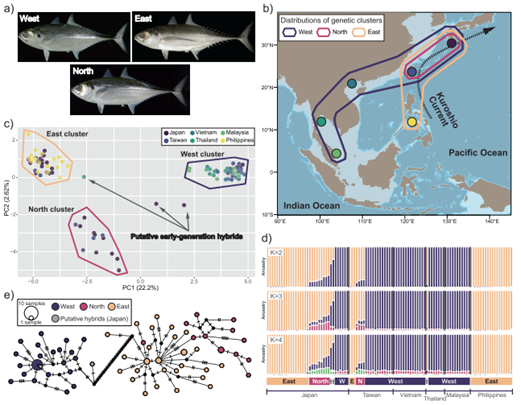
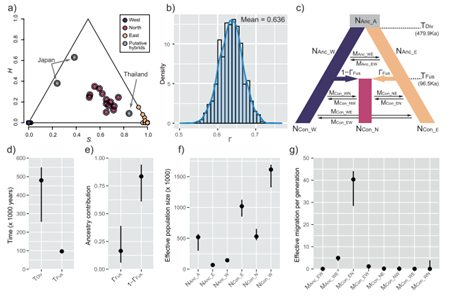
Figure 2.
Estimation of ancestry index (S) — equivalent to the hybrid index — and heterozygosity level (H) in hybrid individuals based on HIest analysis, assuming the Eastern group and Western group as the parental populations.
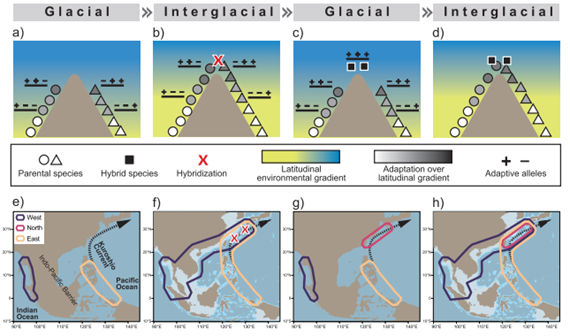
Figure 3.
(a–d) Geo-ecological model illustrating the formation of hybrid species in coastal marine environments driven by Pleistocene glacial cycles. The two parallel coastlines along a landmass are connected at their high-latitude ends.
(e–h) Application of this model to the case of the torpedo scad (Megalaspis cordyla).
Source: ISDI Science and Technology Bulletin.
- The Vietnam Academy of Science and Technology (VAST) participates in the National Exhibition on Vietnam’s Achievements on the occasion of the 80th Anniversary of the National Day (September 2, 1945 – September 2, 2025).
- Research and Proposed Solutions to Enhance Carbon Stocks in Vegetation Cover across Hai Phong City
- The Institute of Science and Technology for Energy and Environment and the Quang Ninh Department of Science and Technology sign a cooperation program for the 2025–2030 period.
- First announcement -14th International forum on Green technology and Management – IFGTM 2024
- SUCCESSFULLY ORGANIZED THE TABLE TENNIS TOURNAMENT “VAST SUPER CUP 2024”